

Living Science
From a Rural Perspective
Rooted in the farm life of her youth, sociologist Loka Ashwood works with rural residents to reveal the reasons and solutions for challenges in their communities.
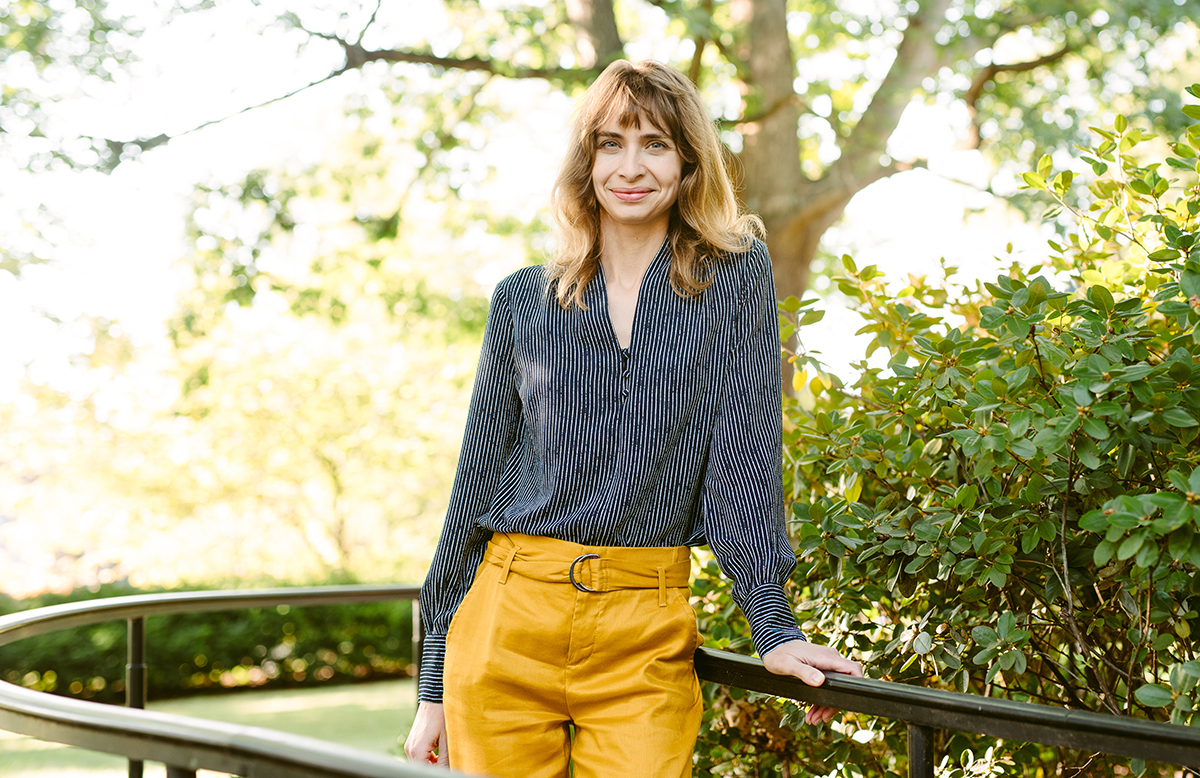
Loka Ashwood PhD’15 was born and raised in a rural community, and rural America is where her heart remains. Her research has settled there with her.
To get a sense of the questions Ashwood tries to answer, look no further than the hardships faced by communities like her home county of McDonough in west-central Illinois — places that often seem underserved or disregarded by the government. Places that endure environmental and health injustices, often tied to unwarranted challenges to land ownership and access at the hands of corporations or extractive industries. She hopes to help rural Americans answer this overarching question: Who benefits from the exploitation of their communities? The truth can often be difficult to discern. And perhaps an even more important question: What can be done about it? Now a professor of community and environmental sociology at CALS, Ashwood has worked in rural areas in Alabama, Georgia, Kentucky, Illinois, and Wisconsin, and she’s expanding her scope to national and international scales.
You were raised on your family’s farm in rural Illinois. How does your upbringing motivate and inform your work?
It’s superimposed over everything I do, for better or for worse. I grew up between the towns of Vermont and Industry in Illinois. And then I went to Northwestern University, just outside of Chicago, as an undergraduate. That was such a shocking experience, to be in an urban context, and I’ve never forgotten that. It felt so lonely. So I had this incredible access to the university but also this feeling of isolation. Having experienced that, it influences my approach to students in my classroom, particularly to those who come from rural areas and perhaps don’t feel like they belong.
Also, seeing the decline of the area where I grew up had a huge impact on me. The rise of poverty there, and crime, issues that I first explored in the Deep South and now in the Midwest. I experience all of this so personally. Fortunately, as a rural and environmental sociologist, I get to work with rural people to answer questions that concern them and their communities. And given that the topics I work on are derived from relationships with communities, I aim to be translational with my work — writing and delivering findings in a way that anyone can understand and access, sharing what’s usable and helpful.
And approaching these problems, which are always interdisciplinary questions, means I get to work with people from so many different fields. It’s never just sociology. Sometimes it can include environmental engineering or geology or law or anthropology. I’ve been able to work with so many different scholars, and that’s an exciting part of what I do.
Can you describe a research project along these lines that you’re working on now?
I’m conducting oral history interviews that help map the locations of former rural homesteads. It’s well-documented that the number of farms in the U.S. is in decline, but we don’t really pay much attention to rural homes, and they are of such historical significance. For example, where I grew up, many farmhouses were bulldozed or burned and now live only in memory. They’re just being erased. People in rural areas often haven’t had a chance to mourn these losses.
So, to enliven those memories and help record this vital history, I am working with [state cartographer] Howard Veregin and [geospatial outreach specialist] Mike Hasinoff at the Wisconsin State Cartographer’s Office to create an online, interactive map where the public can access the platform and indicate where they know rural houses and related farm structures once stood. It’s a public service, and it’s participatory. Wisconsin’s going to be the focus, but we’re also including Illinois and Kentucky. The results will help us see trends. When we know the areas where the most homesteads have disappeared, we can contextualize that with U.S. Department of Agriculture and voting data and start to understand the political and economic reality in rural places and help support change by dignifying the past.
This will also be an opportunity for UW students. I’ll be teaching a course, Community and Environmental Sociology (CES) 499: Independent Study in Engaged Sociology, where students can work with the state cartographer’s office and me to learn how to mix oral histories with GIS [geographic information system] mapping. They’ll be able to help document these important rural histories while learning new skills — how to map and conduct effective interviews to create data that can make change.
How can people get involved in this project?
They can visit our Lost Rural Home website and directly map lost rural homesteads at this very moment. If they would also like to be interviewed to record their story, they can get in touch with me directly at ashwood@wisc.edu or 608-262-4239.
What other research projects are you working on at the moment?
Another ongoing project is a continuation of some intensive, qualitative, community-based research. I have examined corporate ownership of land and also industrial animal facilities. In both areas of work, we found emerging models where absentee and sometimes foreign-owned entities use limited liability companies to mask their identities. In the hog industry, we found 18,000-head hog gestation sites were being proposed in rural areas, and the names associated with them just had an LLC at the end, so people didn’t know who or what was behind it. It wasn’t the local hog producer they knew from years ago because that industry collapsed in the 90s.
My dissertation had a similar focus. In rural Georgia, LLCs were being used to take land through eminent domain or to exploit “heirs’ property” (family-owned land passed down informally through generations), which is very traditional among Black farmers in the Deep South. Again, they didn’t know anything about these LLCs that were proposing to take their land.
Where did you take it from there?
I started to branch out with great, smart people, like [UW sociology graduate student] John Canfield, and, at the University of Kentucky, [communication professor] Andy Pilny and [sociology graduate student] Mohammad Khalilian. We started to work our way up, asking questions. Is this LLC a subsidiary of another company? Who are its investors? Are they absentee owned, meaning from outside of the county, state, or the country? The answers motivated us to look globally across nine agricultural sectors using big data. We started with the largest agribusiness powerhouses to see if they’re intertwined through LLCs or their equivalents in other countries, to see how much anti-competitive activity is going on. And we’ve been looking at leaders at these companies who own the most shares and firms that own shares in each other, or subsidiaries of one another, and are the ultimate beneficiaries.
Now we have a dataset with more than 20,000 relationships and 16,000 entities — firms or people that are the predominant actors among what we often consider to be only 47 entities — and I am working with Caitlin Bourbeau and undergraduate Nadia Choi at the UW Applied Population Laboratory in my department to make it public at acre.apl.wisc.edu. It will be an interactive database, so people can click through and find for themselves which people or firms are the most interconnected.
How would you like to see this database get used?
I hope it’s empowering. One of the main groups I thought of as users of this is farmers who are trying to understand why their input costs keep going up. It might help them feel less self-blame if they understand the larger context of what’s going on with corporate consolidation in agriculture. For students, it’s helpful to move past the grocery store shelves and understand the companies involved in agriculture. And for rural people in general who may be dealing with injustices related to this concentration or a proposed facility, they can figure out more easily who makes money off these efforts that are not necessarily good for rural communities. The database unveils a vast social network and shows that much of the power in the world is based on relationships. But if we understand that our relationships are also a form of power, I think we can take on consolidation and antitrust in better ways.
You mentioned students learning from using the database. What else is on the horizon for you for in terms of teaching?
I created a new course called CES 290 Activating the Ecological Society. Students get to identify a community issue — maybe one in their own hometown — and learn how to make an action plan for resolving that issue and how to acquire skills to facilitate that action. They will learn the social-ecological context of the community and how to work within the community frame to make change. As with any of my classes, I want them to come away with the knowledge that change is possible, and that they are equipped with the skills to make it happen.
⊕ More About Loka Ashwood
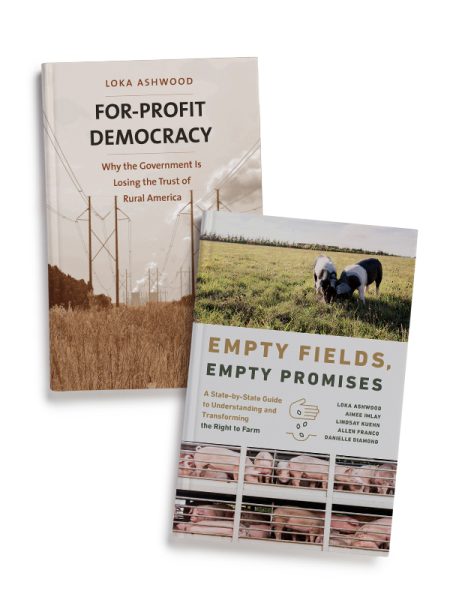 Ashwood was named a MacArthur Fellow in 2024. Her published books include For-Profit Democracy: Why the Government is Losing the Trust of Rural America (Yale University Press, 2018) and Empty Fields, Empty Promises: A State-by-State Guide to Understanding and Transforming the Right to Farm (The University of North Carolina Press, 2023), which is available for free online through the open access book platform OAPEN.
This article was posted in Economic and Community Development, Healthy Ecosystems, Living Science, Spring 2026 and tagged Community and Environmental Sociology, Loka Ashwood, Rural Communities.