

Front List
The Land of Milk and Honey
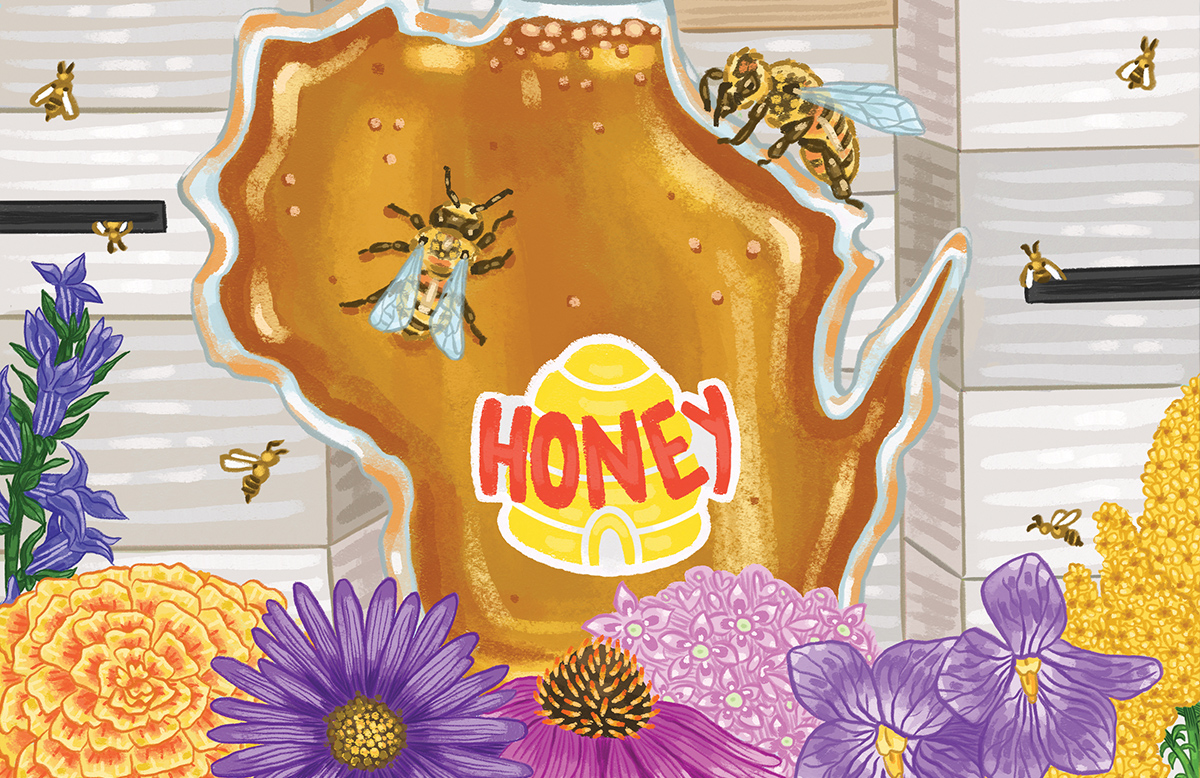
In a state known for dairy, honey is not the first agricultural product to come to mind. But there’s more honey in the Badger State than one might expect, and there’s more to learn about this sweet substance than many people realize. Here’s a jarful of interesting, helpful, and perhaps unfamiliar honey facts.
1. Wisconsin is one of the nation’s top honey-producing states.
Typically a first-15 finisher in terms of yield (and as high as 8th in some previous years), Wisconsin came in at 11th in 2024, with an average of 44 pounds of honey per colony. The state’s total production in 2024 was 2.51 million pounds, valued at $8.85 million.
2. Honey production has a long, storied history in Wisconsin.
The state’s early Indigenous peoples used the crush and strain method of honey extraction. It’s the oldest-known method, and it’s still used commonly today. However, this labor-intensive process results in the destruction of honeycomb and places greater stress on bee colonies. Other, less invasive methods came later. Some of these methods were developed and shared through organizations such as the Wisconsin Beekeepers Association (now the Wisconsin Honey Producers Association, or WHPA), which can trace its origins as far back as 1864.
The WHPA connects honey producers, and it advocates for the industry. In 1965, the association established the Wisconsin Honey Queen Program, a first-of-its-kind promotion and education program that led to the development of the American Honey Queen Program. With such a strong backing for honey businesses, the industry has thrived for many decades. At the 2025 Wisconsin State Fair, the WHPA celebrated 75 years as a vendor, making it the oldest of the fair’s featured Wisconsin commodities.
⊕ Get the Honey Buzz
Find out more about Wisconsin’s honey industry on the Wisconsin Honey Producers website, or find locally produced honey with this online honey locator.
3. Honey is just flower nectar transformed by bees. Honeybees visit 50–100 flowers during each flight to gather nectar from flowers and trees. Nectar then travels to their “honey stomachs,” which contain enzymes that help break down complex sugars into easily digestible simple sugars. Back at the hive, worker bees deposit the digested nectar into the honeycomb’s hexagonal cells. The constant fanning of 60,000–80,000 bees’ wings draws moisture from the nectar, transforming it into the sugary, sticky substance that Americans, on average, consume two pounds of each year. Different nectar sources create distinct honey varietals with unique flavor profiles. Wisconsin has more than 30 varietals, including the rare cranberry honey, harvested from the blossoms of a native Wisconsin fruit crop.
4. Eating honey is associated with many health benefits.
The varietals with the most medicinal properties — buckwheat and star thistle — are used to soothe sore throats and minor burns and wounds. Seasonal allergy sufferers can often alleviate symptoms by eating local honey — it’s filled with regional pollen, so it can help build tolerance to area allergens and strengthen immune systems. Daily consumption of honey can improve health by lowering blood pressure, promoting the growth of good gut bacteria, and providing antioxidants that counter the effects of free radicals.
5. When it comes to cooking, honey has its own rules.
If using honey as a substitute for sugar, it’s important to replace 1 cup of sugar with only three-fourths cup of honey. And, when baking with honey, some other adjustments include reducing the recipe’s liquid measurements by one-fourth cup and turning the oven down by 25 F. Lighter-colored honeys such as wildflower and clover make great salad dressings and are the most versatile, while darker honeys such as buckwheat are best for marinating meats and producing a stronger taste profile.
Emily Sydow is a sophomore majoring in agricultural and applied economics with a certificate in public policy. She was crowned Wisconsin Honey Queen in January 2025, completed her term in November, and represented Wisconsin at the American Beekeeping Federation Convention in Mobile, Alabama, in January 2026.
This article was posted in Food Systems, Front List, Spring 2026 and tagged Honey.