

Class Act
A Purpose-Driven Path
Personal experience and a CALS precollege program guide Naureen Kamal to her own unique mission.
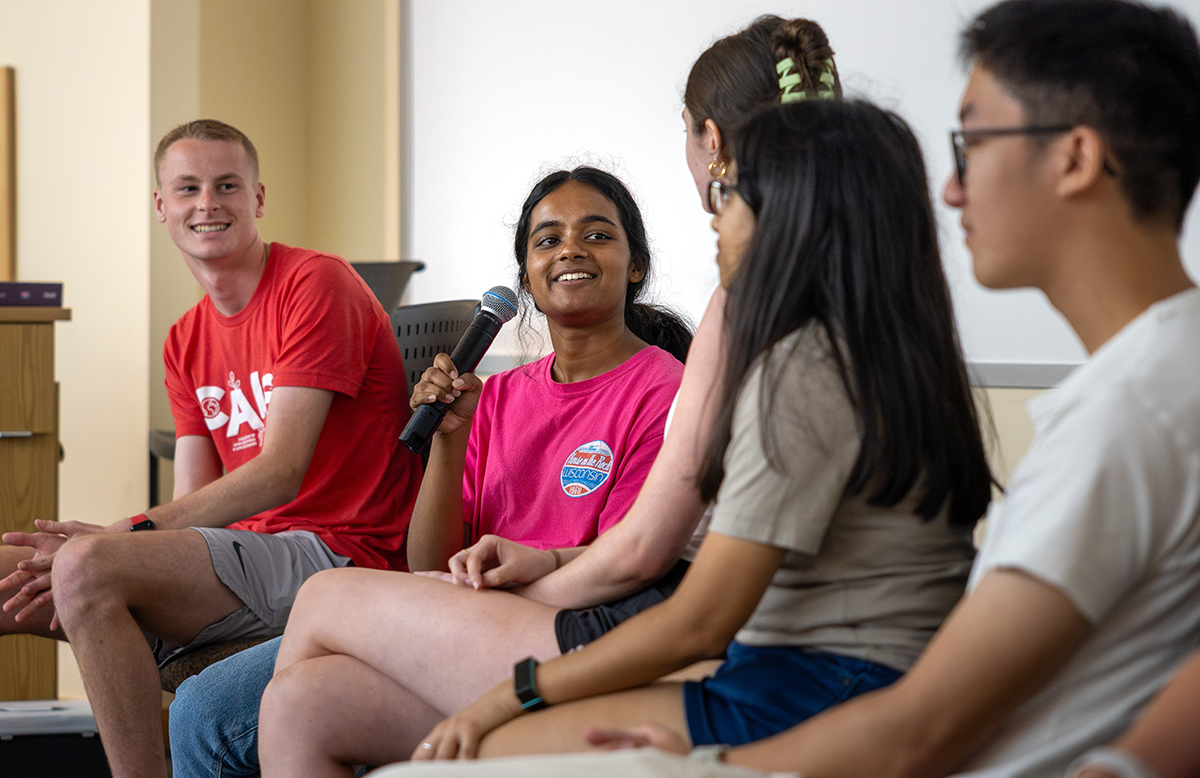
In the aftermath of her grandmother’s diagnosis with dementia due to Alzheimer’s disease, Naureen Kamal BSx’26 developed a keen interest in the life sciences. She perceived these disciplines to be the key to understanding — and perhaps ending — such a devastating condition.
But, as she approached her first semester at UW, she was anxious to get on campus and find her place in a sea of scientific fields. Her decision to join a CALS pre-college program influenced her whole college experience, and it helped her find a life sciences niche where she could contribute to a greater understanding of Alzheimer’s.
Kamal stepped onto campus in June 2023 to begin her time with QuickStart, an “early start” program for incoming first-year students at CALS. As she connected with her peers, as well as faculty and staff, she quickly felt her pre-college nerves ease. Not only did Kamal gain early exposure to academic life at UW, she also made close friendships within the CALS community. And she found direction.
“I didn’t know what specifically I wanted to study when I started college,” Kamal recalls. “QuickStart helped me discover the genetics and genomics major, which aligned well with my interests. The program also allowed me to see that it was feasible to be involved with my passion for studying Alzheimer’s disease.”
While Kamal’s personal connection to Alzheimer’s sparked her desire to discover more about the science behind the disease, QuickStart showed her actionable ways to get involved. The program exposed her to the research landscape at UW and helped her identify labs that would be a good fit.
Kamal now conducts research in the lab of Barbara Bendlin, a professor of medicine at the UW School of Medicine and Public Health. Bendlin’s lab is part of the Wisconsin Alzheimer’s Disease Research Center. There, Kamal works on an independent project exploring the effects of appendectomies on individuals at high risk for Alzheimer’s disease.
“Genetics plays a big role in Alzheimer’s research, but environmental factors can also determine many key components of the disease,” says Kamal, who is also pursuing certificates in global health and health policy. “Understanding the pathology of this complex disease is challenging, so I am grateful to work in a positive environment with a collaborative team.”
After benefitting so much from QuickStart during her transition to college, Kamal returned to the program as an undergraduate fellow in her sophomore and junior years to serve as a guide for others. She also signed on as a fellow for the Wisconsin Rural Scholars Program (see A College Try at CALS, Grow, fall 2025). She worked with program director Tanya Cutsforth BS’08, MS’10 to show students and teachers from all over the state what CALS (and college) is all about.
“Naureen is a true rockstar,” Cutsforth says. “A stellar student, engaged in her community, and doing really important work in healthcare to prepare her for the future.”
Now a pre-med student with two years of experience as a certified nursing assistant in the UW Health ICU, Kamal is interested in exploring the intersection of public health and policy. She hopes to continue working with complex diseases like Alzheimer’s through patient care and research, but also by addressing the broader systems that influence access to treatment and preventative care.
“My grandmother’s diagnosis is always in the back of my mind,” Kamal says. “Everything I’m working toward goes back to wanting to make a difference for families like mine. I am grateful QuickStart gave me the direction to begin building a career around that mission.”
This article was posted in Beyond classroom experiences, Class Act, Health and Wellness, Spring 2026 and tagged genetics and genomics, health care, QuickStart, Wisconsin Rural Scholars Program.