

Follow-Up
Success of Marine Protected Areas Is No Fish Story
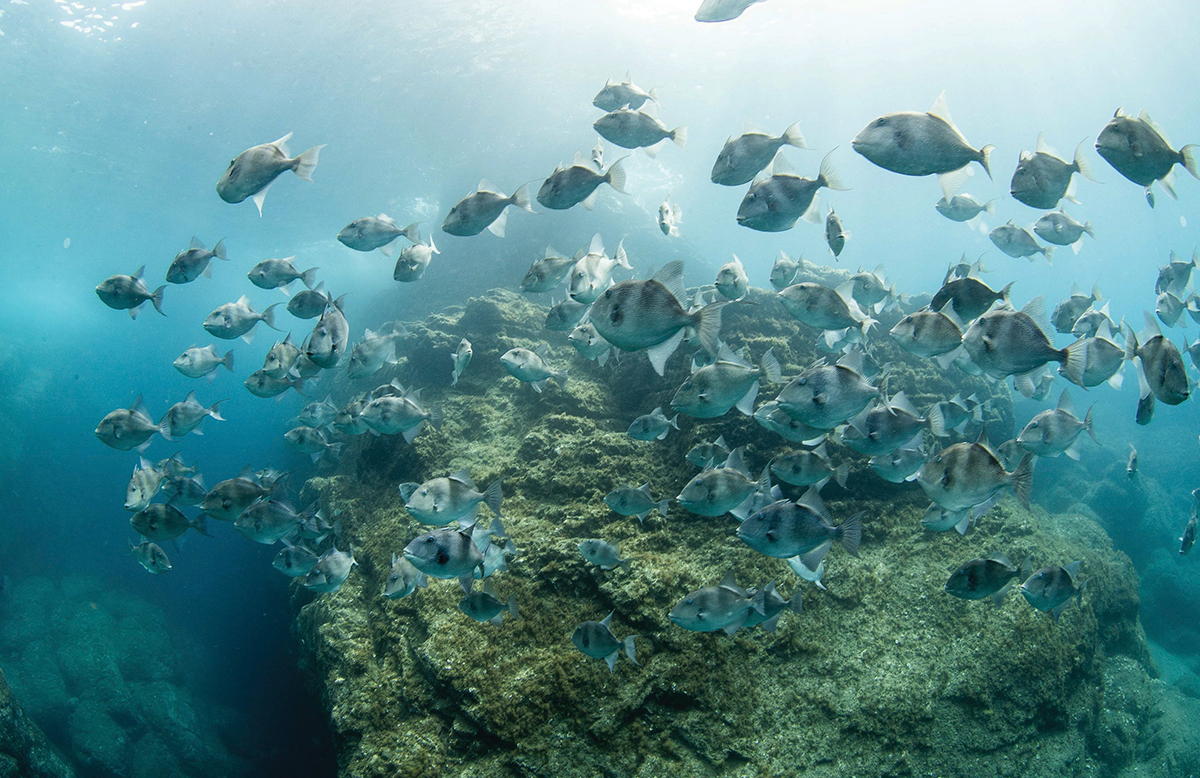
In A Win-Win-Win in Hawaii (Grow, spring 2023), Elise Mahon highlighted a study of the ecological, economic, and cultural benefits of the Papahānaumokuākea Marine National Monument, the world’s largest marine protected area (MPA).
The study, coauthored by assistant professor of forest and wildlife ecology Jennifer Raynor, showcased the concept of “spillover” from MPAs. MPAs restrict where fishing is allowed. Raynor’s study found that these protected waters give fish species a chance to flourish, causing an increase in overall population that can spill over beyond the MPA and increase fisher’s catch rates and profits. The monument also preserves important cultural sites for Native Hawaiians.
Raynor has since followed up with research that supports these findings in a global context. Her recent work shows that artificial intelligence methods applied to satellite data provide a powerful new way to assess industrial fishing activity in MPAs and eliminate blind spots in current monitoring methods. The first-of-its-kind study, published in July 2025 in the journal Science, found that the world’s most strongly protected MPAs experience little-to-no industrial fishing activity. The results bolster the idea that, by helping the ocean recover from fishing pressure, MPAs boost biodiversity inside their boundaries but also replenish fish populations in surrounding areas.
“We found that MPAs with strict legal fishing bans work better than critics claim,” Raynor explains. “MPAs can help to regenerate fish populations, which creates strong incentives for illegal fishing — and yet, that activity was mostly absent. This is good news for marine conservation.”
⊕ This study was funded by National Geographic Pristine Seas.
This article was posted in Economic and Community Development, Follow-Up, Food Systems, Healthy Ecosystems, Spring 2026 and tagged biodiversity, Forest and Wildlife Ecology, Jennifer Raynor, Marine Protected Areas.