

Feature
A Grower’s Vision, a Dentist’s Brew, and a Farm’s Revival
With a green thumb and beermaking prowess — and a little help from their hardworking family — two alums have created a thriving, sustainable agribusiness.
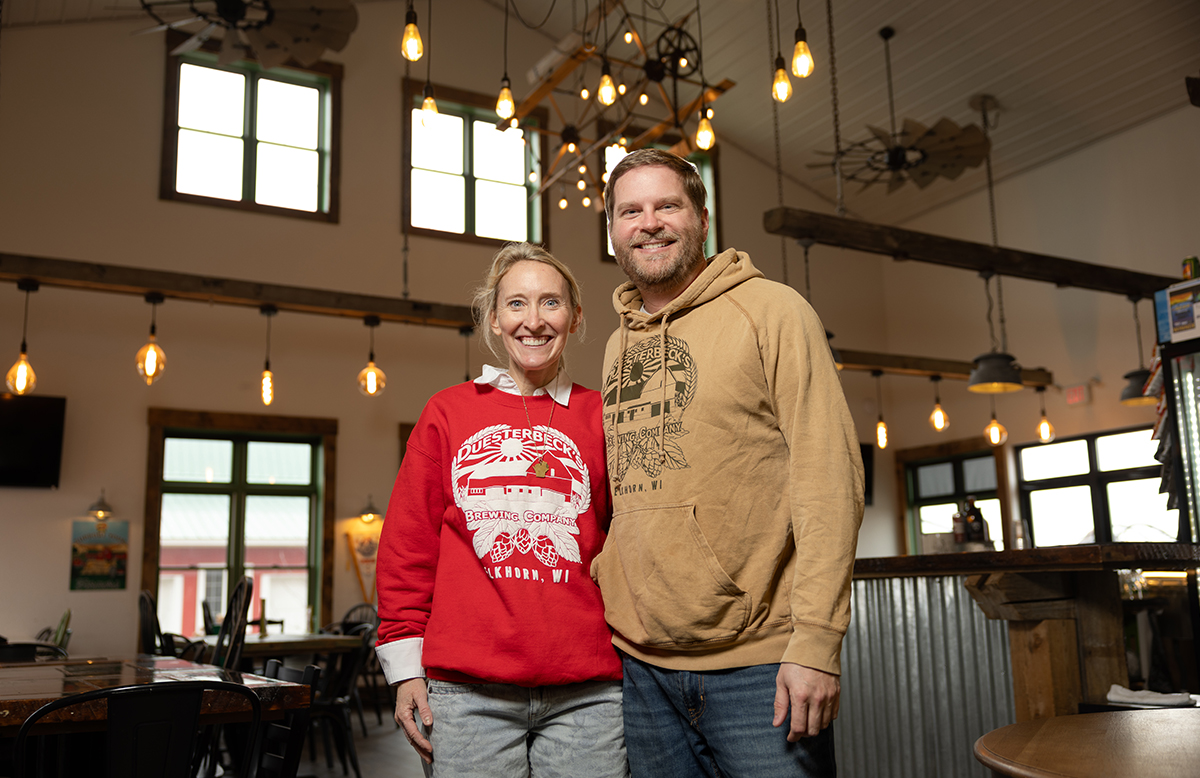
Laura Duesterbeck Johnson BS’03 always felt the pressure of succession when she was growing up on a farm in Walworth County. The property had been with the family since 1861, so her father, Dennis Duesterbeck FISC’67, kept a close eye on the future of the operation. And Laura, one of three sisters, had the keenest interest in agriculture. She raised pigs to show at the county fair, participated in 4H and FFA, and loved to garden.
“I think this is an issue on every small family farm: Who’s going to take over in the next generation?” Laura says. “And my dad was always scouting for that. He’d ask, ‘What are you going to do with the farm?’ And I didn’t know. I wanted to be a stay-at-home mom. So that was my goal — to be a farmer’s wife.”
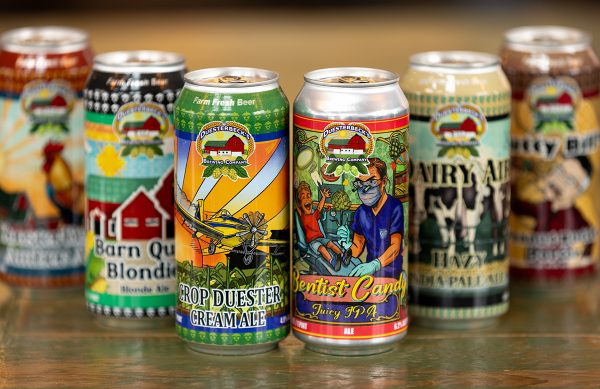
When she enrolled as a horticulture major at CALS in 1999, Laura joked that she was looking for her “Mrs. degree.” She did in fact fall in love with fellow CALS student Ben Johnson BS’04, and they married the summer after graduation. But Ben, a bacteriology major, planned to go to dental school and didn’t have the slightest interest in farming. He did, however, really enjoy brewing beer. And, eventually, kegs of Duesterbeck’s Crop Duester Cream Ale and Barn Quilt Blondie would provide the yeasty breath of fresh air that revived the old family farmstead.
Ben and Laura knew each other at Delavan Darien High School, where they graduated a year apart. They started dating when both lived in Witte Hall. Ben, who had many bacteriology classes in the old Fred Hall (where the Microbial Sciences Building now stands), would bring his lunch across the street to the D.C. Smith Greenhouse, where Laura worked for former greenhouse manager John Mather MS’76. They’d eat together most days in the conservancy. Laura loved taking classes with horticulture professors Dennis Stimart and Jim Nienhuis PhD’82. Nienhuis, she recalls, would issue a friendly challenge to students: If they made a green salsa better than his, he’d give them an A. “I don’t think he ever gave us the recipe, either,” she says.
Ben’s interest in fermentation was more than academic. He began brewing beer in his apartment, and he founded a home brewing club for students. Ben was interested in the scientific aspects of brewing and says that a bacteriology degree also fulfilled the requirements for applying to dental school. While an undergraduate, he did research in the lab of famed virologist Ann Palmenberg and took honors biology classes through the Biocore honors program.
“It was extremely competitive and really helped me stand out as a candidate when applying to dental school,” Ben says.
After graduation and their wedding, the couple headed to Minnesota for Ben’s dental schooling. They had two children while there and came back to Delavan, where Ben started work in a dental practice that he later purchased.
Out on the farm, the clock was ticking. Laura’s dad was in poor health after a heart attack and eventual heart transplant at UW Health. Even before COVID made them commonplace, Dennis wore an N95 mask to protect against the germs and dust of farm life that could be fatal to him. Meanwhile, the Johnson family grew to include six children, and Ben kept brewing beer.
“I built a pretty sophisticated brewery in our basement, here in Delavan, that was kind of pro level,” Ben recalls. “That’s where I was really able to start perfecting my recipes and techniques.”
One day, Ben told Laura he wanted to open a taproom in downtown Delavan. “And I said ‘no,’ ” she recalls. “If you’re going to do it, you’re doing it on my family farm.”
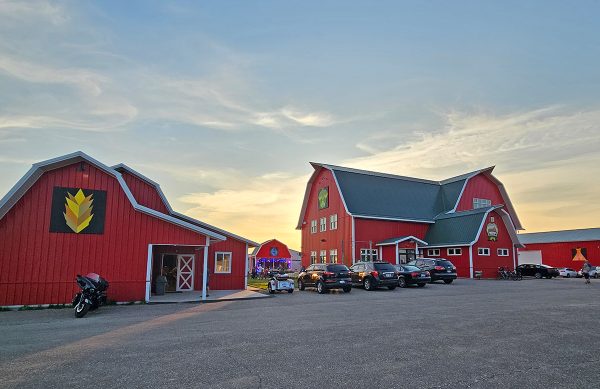
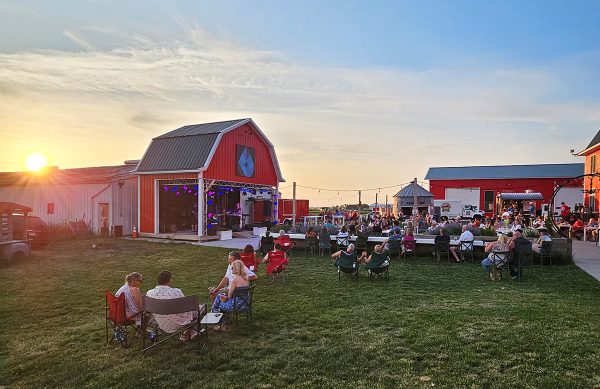
Laura finally had the answer to her father’s worry about the future of the farm, albeit one that would take a lot of labor and investment. The farmstead had several dilapidated buildings filled with generations of farm junk. The Johnsons set to work cleaning and having the property rezoned. They razed the old dairy barn and reused the original beams and barn siding to create a tasting room. The old pig shed became a music hall; the grain bin, an outdoor bar; and the grainery, a gift shop. Today the farm’s green-roofed red buildings look like a toy manufacturer’s version of an ideal Wisconsin farm (but decorated with beer-themed barn quilts created by Laura).
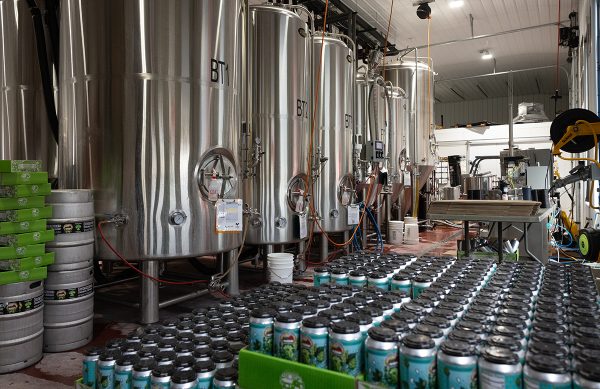
Duesterbeck’s Brewing Company opened in fall 2019 and shut down the following spring during the COVID pandemic. Laura and Ben used the time to create a new patio, and they were so busy when they reopened for outdoor service on Memorial Day weekend 2020 that they ran out of beer. They have since expanded to a 20-barrel brewing operation with a full-time brewmaster.
Despite Ben’s worries that no one would find a brewery “in the middle of nowhere,” the place is rocking on summer weekends, when they host outdoor music events. Laura estimates that 70% of their warm-weather customers are vacationers from the nearby Lake Geneva, Delavan Lake, and Lauderdale Lakes resort areas.
The Duesterbecks extend their community beyond the farm by creating beer for events at Old World Wisconsin in Eagle and the Yerkes Observatory in Williams Bay. They feature local products, too, including the honey for the Bees Be Crazy Hefeweizen Ale, grown by CALS alum and Duesterbeck’s bartender Rick Henningfeld BS’05. One of Rick’s brothers, Frank Henningfeld, runs the family dairy farm while another, Ron Henningfeld BS’07, turns the milk into Hill Valley Dairy’s cheese curds, also for sale at the brewery. They use apples from the Apple Barn orchard up the road to make hard cider seltzer, and Laura grows hops and jalapeños that flavor their beers.
People who want a snack with their beer can opt for pretzels from the local German bakery or Blue Farm tortilla chips grown near Janesville. In the summer months, Laura buys plants from her horticulture classmate Nick Pesche BS’02, whose family operates a greenhouse near Lake Geneva.
Beyond supporting local products, the Johnsons are also proud of their commitment to sustainability.
“We’re the largest production brewery on a farm in Wisconsin, and we’re the only brewery I know of that reuses 100% of its water.” Ben says. The brewery’s well water goes through a reverse osmosis system. It’s filtered and then has salts added back into the water in quantities appropriate for the style of beer being made. The wastewater is collected, put into holding tanks, and eventually spread on crop land. The spent brewers’ grains are fed to cattle on a nearby farm.
The Johnson children, representatives of the farm’s seventh generation, are finding their role in the brewery operation. Eldest Makai, a graphic design student at UW–Whitewater, creates all the colorful labels, with many of the beers honoring family members: The Pig Farmer Pale Ale is a tribute to Dennis Duesterbeck, who passed away in 2017, while The Old Girl’s Sticky Buns, a stout flavored with vanilla and maple, is a nod to grandma Cathy’s famous breakfast rolls.
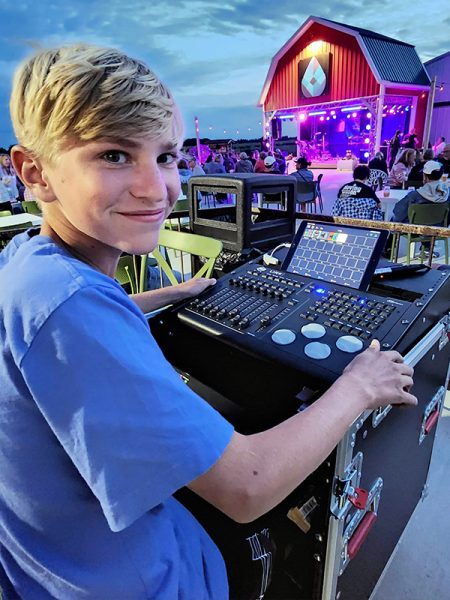
The next oldest, Grace, is a UW–Madison human ecology major who manages the farm’s social media accounts and has owned her own coffee truck at the brewery since she was 15. Son Trae fixes everything on the farm and 3D prints any parts he can’t find. He also runs the sound and drone camera during the summer music events. The younger children, Amari, Boden, and Rosealee, are still growing up and figuring out how they fit into the family business.
By reviving the farm, the Johnsons aim to keep it as a viable business for the next generation.
“It’s teaching them all a good work ethic,” Ben says. “We’re hoping to build something so they will want to stay in the area when they get older — or to give them a reason to come back.
This article was posted in Economic and Community Development, Features, Offshoots, Spring 2026 and tagged Agribusiness, agritourism, Bacteriology, Biocore honors program, farm succession, Fermentation, Horticulture.