

Feature
Lighter Fare for Cattle and Microbes
Rebecca Smith uses genetic tools to develop plants that can be digested more easily. The outcomes could be greater efficiency for biofuel production and lower methane emissions from dairy cows.
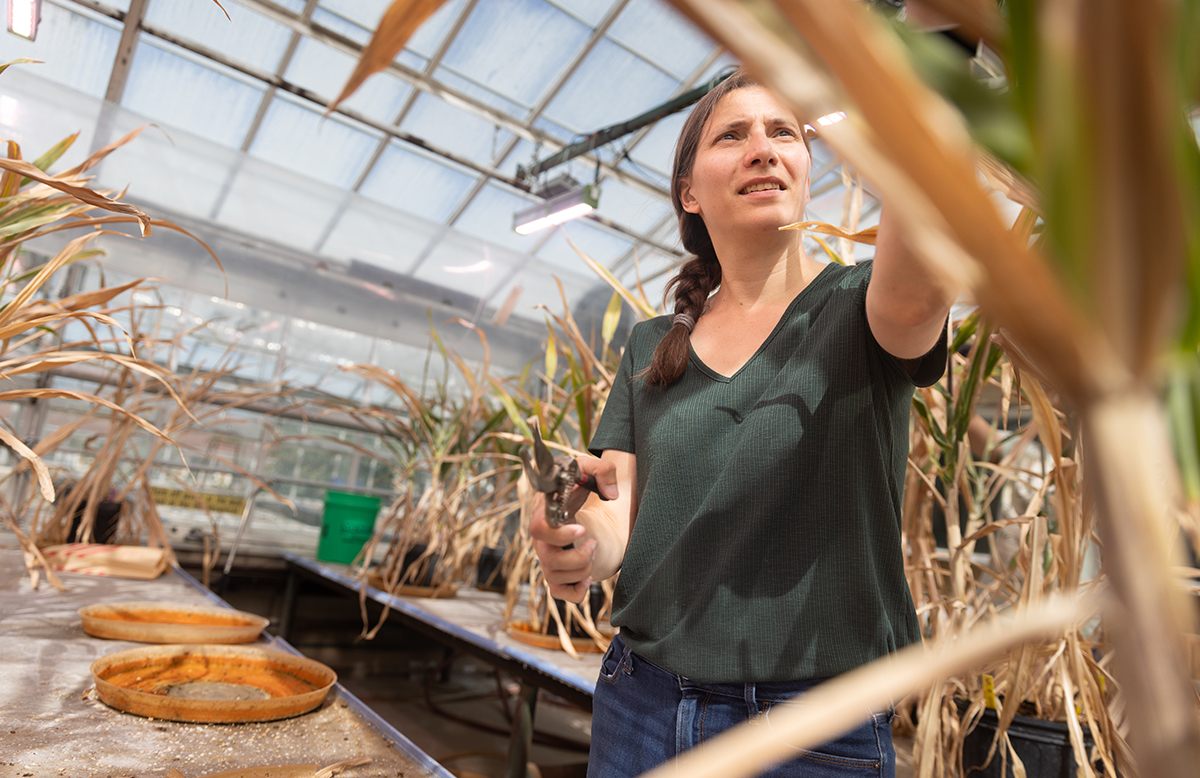
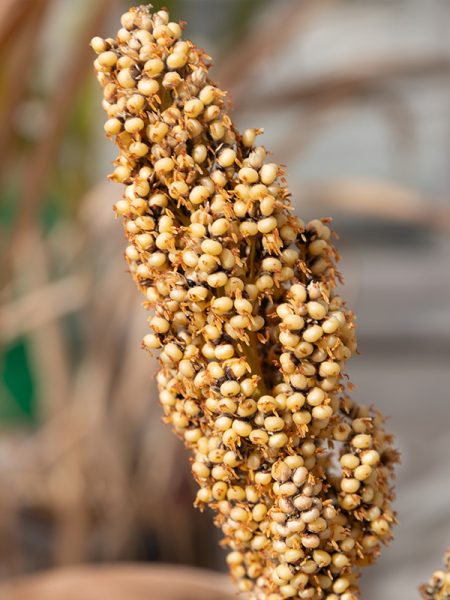
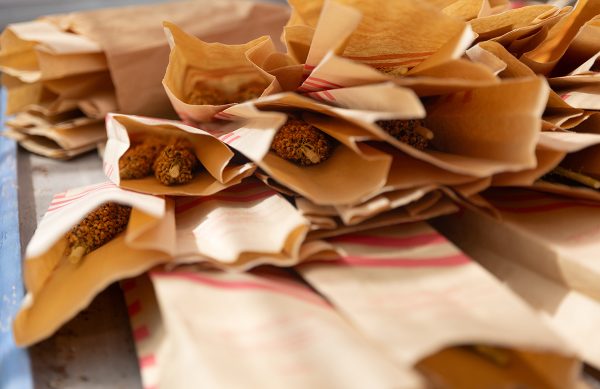
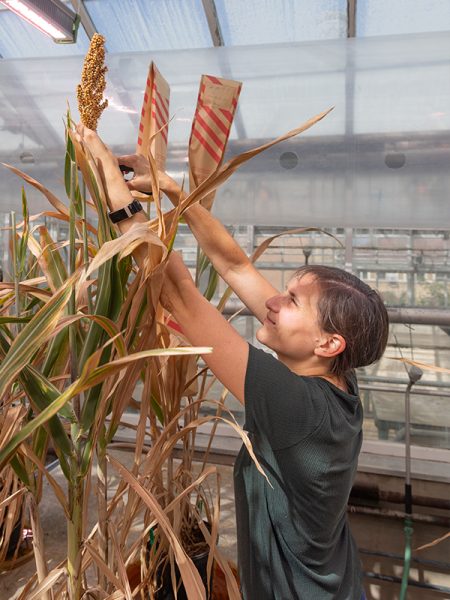
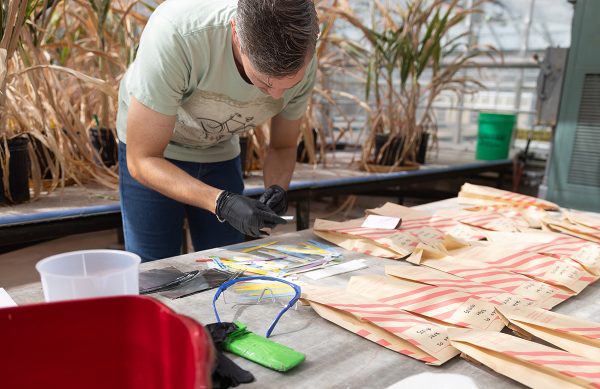
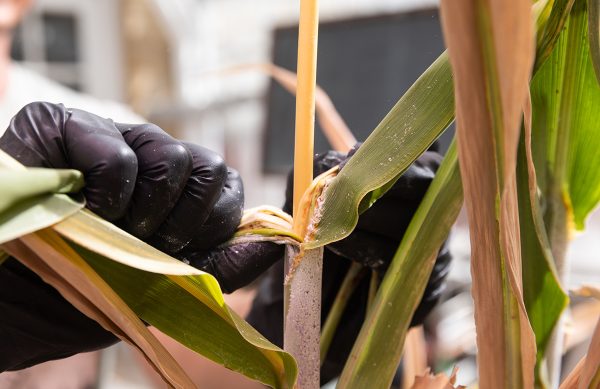
In the King Hall greenhouse on the UW campus, Rebecca Smith stands amid a potted jungle of sorghum, clipping stalk segments into a plastic bin to be weighed and cataloged. Seeds, bagged and labeled, are stacked to the side. Tissue samples have been flash-frozen in liquid nitrogen for chemical and genetic analysis.
The plants have an extra piece of DNA that increases their production of a chemical that weakens bonds in the cell walls. The walls are like bank vaults full of carbohydrates; the goal is to make it a little easier to break in and turn those sugars into energy.
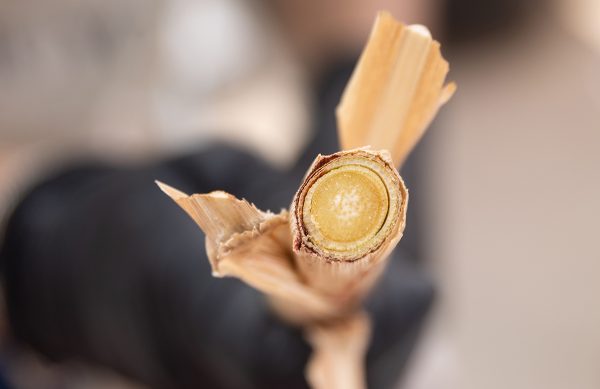
With more than 50 plants, it’s tedious but necessary work to figure out which specimens perform best depending on where the extra gene landed and how active it is. “Best” in this case means the plant cell walls are easiest to break down after harvest, but the plants otherwise grow like native sorghum, a hardy crop that withstands arid conditions and produces a lot of organic material, Smith says.
An assistant professor in the Department of Plant and Agroecosystem Sciences at CALS, Smith investigates how forage and bioenergy crops develop at the cellular level. She uses her unique combination of skills to engineer new varieties to help solve some of humanity’s biggest challenges.
As a scientist with the Great Lakes Bioenergy Research Center (GLBRC), Smith spent the past decade researching ways to grow non-food plants as feedstocks for fuels and chemicals traditionally derived from petroleum. Now, as a new member of the Dairy Innovation Hub, she is working to grow crops that are easier for cows to eat. Both projects aim to make farming more sustainable, bolster rural economies, and ultimately reduce greenhouse gas emissions.
“The goal is to improve digestibility,” Smith says. “There are synergies in what makes a good plant for biofuel and for feed.”
The Problem with Lignin
Underpinning Smith’s research is a basic problem: With the exception of fruits and grains, plants store chemical energy in the form of carbohydrates that are hard to access.
Plants evolved to grow and survive often hostile conditions — gravity, wind, and predators, to name a few — and create their own food by using sunlight to combine carbon dioxide from the air with water from the earth. A key part of that survival strategy is lignin, a chain of molecules (or polymer) bound to the sugars in the cell wall that helps ward off pests, repel water, and provide structural support.
Just as it protects plants in the field, lignin acts as a barrier to the energy stores — whether in a biorefinery or a cow’s gut. As a result, lignin is one of the biggest obstacles to producing cost effective advanced biofuels, which are made from plant fiber rather than corn kernels or soybeans. And it’s hard for cows to digest, which means they get less energy from their feed, and they burp more methane, a potent greenhouse gas.
The challenge is to grow plants with less lignin, or lignin that’s easier to remove, without affecting overall growth and development.
“We have to use what we know about cell biology so that we can manipulate lignin in specific cell types rather than in the entire plant,” Smith says. “No farmer wants to grow a plant that is going to fall over or is going to be ridiculously short.”
Plant Chemistry
The daughter of a musician and an English professor, Smith grew up in Winnipeg, a city of about 843,000 people situated 135 miles north of Grand Forks, North Dakota, in the Canadian province of Manitoba. Drawn to science from an early age, Smith initially wanted to be a veterinarian, but she changed her mind after a job shadowing experience.
“I only needed to see one dog get neutered,” she says. Her “ah-ha” moment came while studying for a high school biology exam amid her mother’s house plants.
“Things just started clicking in my brain,” Smith says. “It was just that concept of plants taking in carbon dioxide and turning that into energy, and then they’re releasing oxygen, and they’re supporting our life on Earth.”
In college she discovered what would become her core research interest: secondary (or specialized) metabolites, chemicals that perform helpful functions, such as protecting the plant or sending signals, but often aren’t essential for survival.
“Plants are producing these ridiculously complicated molecules, and we understand a lot of times what their use is for us but have very little understanding of why the plant is putting so much energy into making them,” Smith says. “It was just absolutely fascinating.”
After her initial plans for graduate school fell through, Smith contacted Lacey Samuels, a professor at the University of British Columbia, who invited her to work on a project investigating how plants form lignin.
“I’d learned about lignin,” Smith says. “But I’d not really thought about lignin very much.”
Plants typically use enzymes that hook molecules together into polymers. But lignin is pure chemistry; it forms when unpaired electrons cause individual molecules (or monomers) to link together in unpredictable ways.
“You can’t really predict how those monomers are going to come together, what bonds are going to form between them, because it all depends on chemistry,” Smith says. “It looks different from one cell to another, even if the cells are right next to each other.”
Lignin also happens to be a rich source of ring-shaped molecules known as aromatics, which are found in petroleum and used to make plastics, adhesives, lubricants, and medicines, though the complex structure makes it hard to break them apart into useful components.
Smith decided that to really understand lignin she needed to learn more about chemistry and the techniques used to analyze it. So, in 2013, her final year of graduate school, she visited the lab of John Ralph, an internationally recognized expert on lignin known for his pioneering work in structural analysis. At the time, he was a biochemistry professor at CALS.
Realizing Smith had much-needed expertise in plant physiology, Ralph hired her the next year as a postdoctoral fellow with GLBRC, a federally funded research center based at UW that works to enable the cost-effective production of biofuels and chemicals from non-food plants.
Smith was later promoted to staff scientist and eventually established her own lab, contributing to dozens of studies identifying ways to reduce lignin content, make it easier to break apart, or incorporate more valuable compounds.
Easier Digestion
Bioenergy crops — including grasses and trees — pull carbon from the air and can be grown on land unsuitable for food production, so they could be renewable sources of transportation fuels and petroleum-derived products, such as plastics.
Microbes can ferment the plant sugars into alcohols and convert lignin components into valuable chemicals, but only after the biomass is broken down, which requires a lot of energy and chemicals that can inhibit fermentation.
Cattle and other ruminants break down feed with the help of microbes in the rumen, the first in a series of stomachs. The amount and structure of lignin in the plant determines how much time and energy it takes to free up the carbohydrates. And the longer it takes to digest, the more methane a cow produces.
To confront these challenges, Smith uses multiple methods, including gene editing tools such as CRISPR, to identify the genes involved in lignin formation and dial them up or down to modify the lignin content and structure. In the case of biofuels, that translates to more efficient refining and, ultimately, products that can compete with fossil fuels on price.
“We’re making it easier to get to the products,” Smith says. “The less chemicals and energy we have to put into breaking apart the plant, the easier it is to bring the cost down.”
For cattle, it means better health and fewer burps, which Smith says could make the dairy industry “a little more sustainable.
Global Problems, Cellular Solutions
As a graduate student, Smith had assumed she would spend her career studying the basic biology of plants. But after coming to GLBRC in 2014, she realized her skills could help solve bigger problems in keeping with the Wisconsin Idea that university research should serve the public good.
“I always envisioned I’d be doing pretty basic research,” she says. “I’ve become more and more excited over time to do research that will make the world better.”
In 2024, Smith received a faculty appointment at CALS, where she teaches plant science and conducts research for the Dairy Innovation Hub, which was established by the Wisconsin Legislature in 2019 to drive research and development in support of the state’s dairy industry.
Smith is also part of a precision agriculture project that integrates plant genetics, animal nutrition, microbiome physiology, and artificial intelligence. The project’s goals are to develop plants that improve feed efficiency, reduce methane emissions from dairy cows, and require less fertilizer.
With $7.8 million in annual state funding, the Dairy Innovation Hub has supported more than 260 research projects and 23 faculty positions at UW–Madison, UW–Platteville, and UW–River Falls working in four research areas: land and water; animal health; human health and nutrition; and farm business and community.
The hub’s faculty director, professor and soil extension specialist Matt Ruark, says crop development has emerged as “a huge need” that Smith has filled.
“We had focused a lot of stuff on the land and water side that was more about soil and crop management versus plant development,” Ruark says. “It was a missing piece.”
Ruark says Smith’s research addresses two key metrics for dairy farmers: quantity and quality. And while the hub primarily supports applied research to improve productivity on the farm, Ruark says it’s critical to have scientists like Smith whose scope is cellular.
“Now we have this nice spectrum of scientists working across these scales,” Ruark says. “There’s nothing to take to the field unless she’s doing work at her level.”
Ralph, now retired, says Smith has had a positive impact on GLBRC, and her unusual combination of skills makes her a valuable member of the university faculty.
“I was so glad we could retain her on this campus,” Ralph says. “There are very few that can do good analytics as well as good plant characterization and transformation work. She’s a superstar. She has really good ideas — excellent, researchable ideas— and knows how to go about them and knows the pieces she needs to make a good story.
This article was posted in Bioenergy and Bioproducts, Features, Spring 2026 and tagged biofuels, Dairy Innovation Hub, feed, Great Lakes Bioenergy Research Center, lignin, methane, plant and agroecosystem sciences.